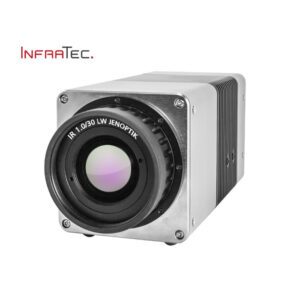
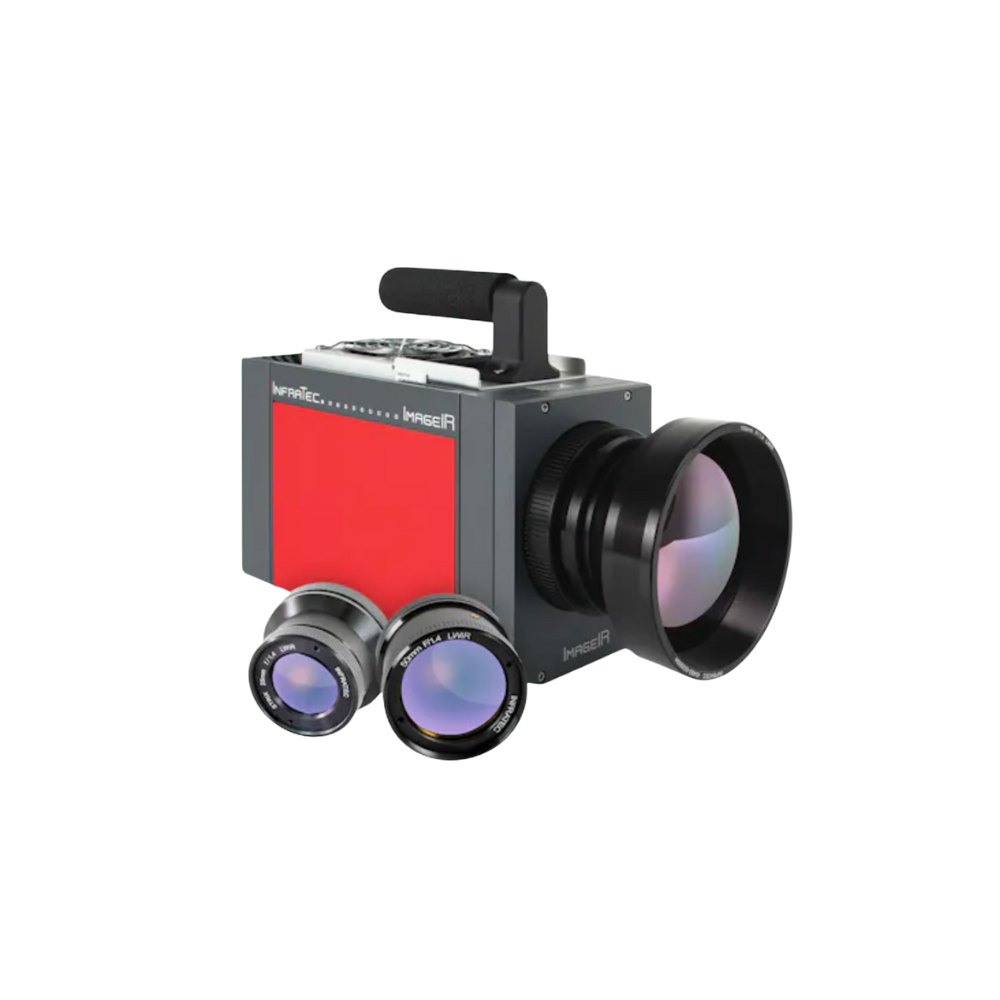
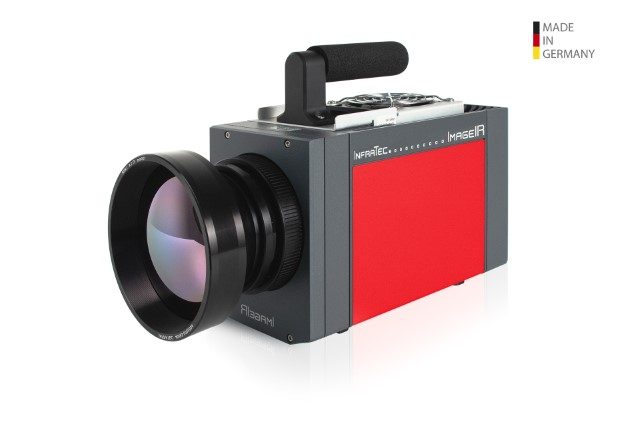
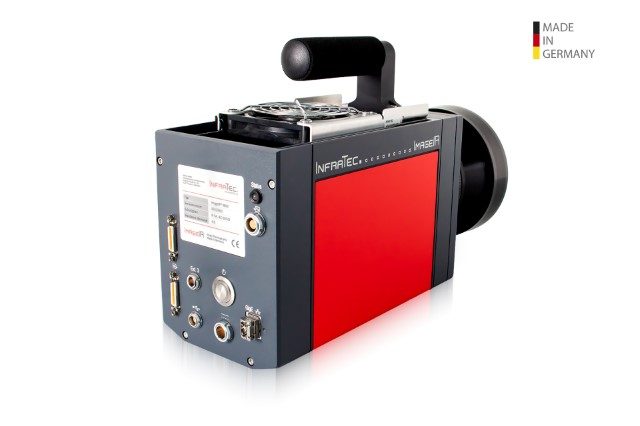

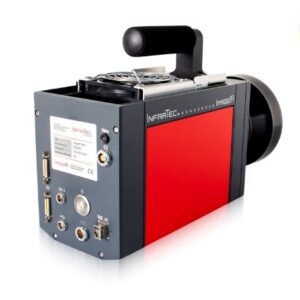
Monitoring the condition of wind turbine rotor blades during operation presents a major challenge for many standard infrared cameras. The ImageIR® 9800, which operates in the LWIR spectral range between (7.7 … 12.5) µm with a cooled photon detector, masters this task with bravura. This camera reliably captures highly dynamic processes requiring extremely short integration times, even at low radiation intensities (e.g., low surface temperatures). Combined with appropriate telephoto lenses, InfraTec’s new ImageIR® series model also allows for temperature measurements of objects located at great distances.
Fast Measurement, Broad Temperature Range
The ImageIR® 9800 allows full-frame images to be captured at frame rates of 180 Hz. In sub-frame mode, the frame rate can be increased to more than three times this value. Thanks to extremely short integration times and snapshot mode – where all detector pixels are exposed simultaneously instead of sequentially line by line – images remain sharp and distortion-free even when test objects move at high relative speeds within the image field. This is essential for accurate, unadulterated thermographic temperature measurement. Precise analysis of fast-moving objects is further supported by a wide range of trigger options for pinpointed, repeatable, time- or event-controlled data recording.
This new high-end InfraTec camera also demonstrates its strengths in tasks such as monitoring combustion gases or exhaust gas flows from vehicles at long distances. Thanks to the HDR function, the ImageIR® 9800 can capture extremely large temperature gradients and variations between -40 °C and 3,000 °C fault-free and continuously. An integrated filter wheel automatically provides filters appropriate for the respective measurement range.
When it comes to detecting thermal signatures and distant objects, the ImageIR® 9800 is the perfect counterpart to the ImageIR® 9400. Both IR cameras are equipped with high-resolution SXGA detectors, cover a wide field of view (FOV), and their spectral ranges – (7.7 … 12.5) μm and (1.5… 5.5) µm – complement each other perfectly.